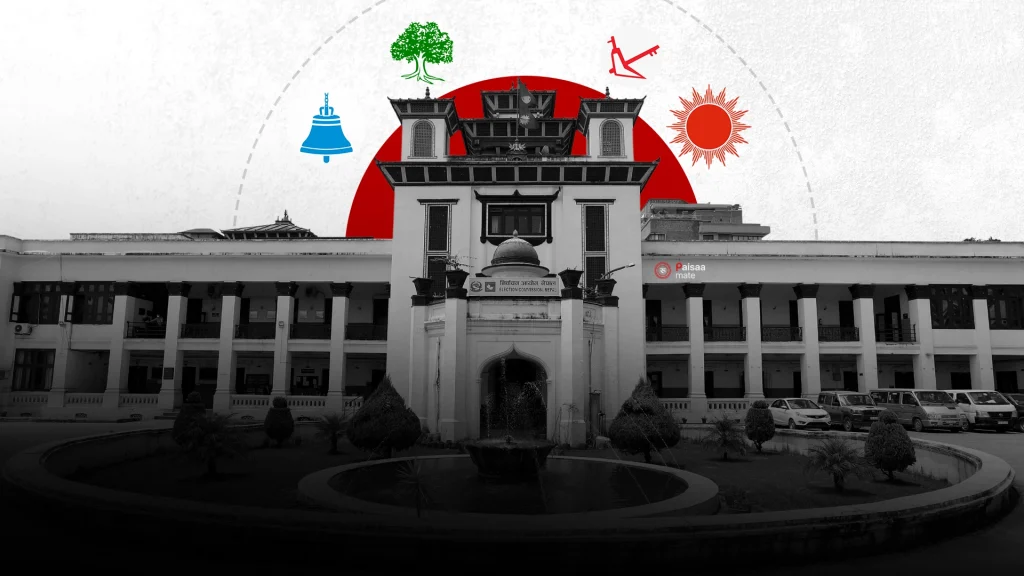
As the March 5 general elections approach, political parties have begun releasing their election manifestos, each packed with bold commitments and far-reaching development plans. Just like in previous elections, the documents are filled with ambitious targets, transformative visions, and promises aimed at winning public trust.
However, this election brings a new dynamic. The contest is increasingly shaped by two broad camps established, traditional parties with long political histories, and emerging new parties positioning themselves as agents of change. Both groups have unveiled their manifestos with strong, confident promises, each claiming to offer the most credible roadmap for the nation’s future.
Nepal’s political and economic discourse has recently been shaped by the ambitious economic targets set by the Rastriya Swatantra Party (RSP). Through its “civil contract” with citizens, the party has proposed bold economic goals: raising Nepal’s GDP to $100 billion and increasing per capita income to $3,000 by FY 2031/32.
While such targets signal strong political will and optimism, a closer look at Nepal’s current economic trajectory raises important questions: are these goals a realistic vision for national transformation, or an illusion built on overly optimistic assumptions?
Nepal’s Current Economic Position:
Nepal’s economic baseline provides essential context for evaluating future projections.
- GDP (FY 2024/25): $42.91 billion
- Per capita income (FY 2024/25): $1,517
To meet RSP’s targets within five years, Nepal would need to more than double its GDP and significantly accelerate income growth.
Nepal GDP Growth Overview:
Historical data from the World Bank shows that Nepal’s long-term average growth from 1960 to 2024 has been only 3.79%, with the last decade averaging around 4.31% and the latest growth rate at 4.61%.
| Particular | Growth % |
| Growth Rate (1960 – 2024) | 3.79% |
| Growth Rate (2014 – 2024) | 4.31% |
| Latest Growth Rate | 4.61% |
Sources: World Bank
South Asian Region GDP Growth Overview:
South Asia’s regional growth averages around 6–6.5%, but excluding India, the rate drops closer to 3.5–3.6%.
| Year | Regional Average (South Asia) | Excluding India |
| 2024 (Actual/Est) | 6.0% | 3.5% |
| 2025 (Forecast) | 6.5% | 3.6% |
Sources: World Bank South Asia Development Update (Oct 2025), ADB Asian Development Outlook (Dec 2025).
GDP Reaction After Major Incident:
Even during periods of national recovery and optimism, such as after the 2008 democratic transition, the 2015 earthquake reconstruction, and the post-COVID recovery, Nepal’s average growth reached only about 5.7%.
| Particular | GDP Average Growth |
| GDP Average Growth after Dethronement of King ( 2008 – 2010) | 5.15% |
| GDP Average Growth After Earthquake & Indian Blockade(2017 – 2019) | 7.75% |
| GDP Average Growth After Covid 19(2021 – 2023) | 4.15% |
| Average | 5.70% |
Nepal GDP Forecasting:
Now, assuming an optimistic annual growth rate of 6.3% on the basis of above 3 conditions high’s average i.e. Highest Historic Growth Rate since 1960(4.61%), Recent Highest Growth Rate in South Asian Region(6.5%) and Nepal’s Best Post-Crisis Growth/after Major Incident in Nepal’s Economy(7.75%). Its average comes at around 6.3% which we had taken as base growth rate. This exaggerative growth rate is taken to actually reflect the maximum limit that Nepal can reach in bestest condition. The country’s GDP would reach approximately $58 billion in five years, taking 6.3% as Economic Growth Rate. This projection already assumes improved governance, capital formation, infrastructure momentum, and stable macroeconomic management as well.
| Year | GDP IN $ Billion |
| Year 0 | 42.91 |
| Year 01 | 45.62 |
| Year 02 | 48.49 |
| Year 03 | 51.54 |
| Year 04 | 54.79 |
| Year 05 | 58.24 |
However, to reach $100 billion within the same period, the economy would need to grow at roughly 21.8% per year. Sustaining such growth consistently for five consecutive years is extremely rare in global economic history and typically linked to extraordinary circumstances.
| Year | GDP IN $ Billion |
| Year 0 | 42.91 |
| Year 01 | 45.70 |
| Year 02 | 55.66 |
| Year 03 | 67.80 |
| Year 04 | 82.58 |
| Year 05 | 100.58 |
Global Comparison: When Does 20% Growth Happen?
Countries that have recorded 20%+ growth usually experienced exceptional events. For example, Guyana achieved rapid growth due to a massive offshore oil discovery. Similarly, South Sudan recorded high growth following oil export recovery. Research from UNCTAD shows that sustained double-digit growth often occurs in small-base, resource-driven, or post-conflict rebound economies. Nepal currently does not exhibit such extraordinary structural catalysts.
| Rank | Country | 2026 Growth (Est.) | Primary Driver |
| 1 | Guyana | 23.0% | Massive offshore oil production boom. |
| 2 | South Sudan | 22.4% | Recovery and stabilization of oil exports. |
| 3 | Guinea | 10.5% | Surge in bauxite and iron ore mining (Simandou project). |
| 4 | Sudan | 9.5% | Statistical rebound following severe conflict-driven contraction. |
Table: The Global Growth Leaders (All Countries)
Countries With Highest GDP Growth for 5 (or More) Consecutive Years:
Different political parties like UML, CPN, UNP, RSP and many more often assume ambitious growth targets, promising directly or indirectly to expand the economy by 9%, 10%, or even more than 20% annually within their five-year tenure. Ambition in itself is not a weakness. History shows that several countries have indeed achieved extraordinary growth rates for sustained periods. The real question, however, is whether Nepal with its limited industrial base, constrained fiscal space, geological constraints and structural challenges, can realistically replicate such performance.
| Country / Economy | Period of Growth | Approx. Annual Growth | Primary Key Drivers |
| Equatorial Guinea | 1991–2005 (14 yrs) | ~24.6% | Oil export boom; extremely small starting base. |
| Liberia | 1995–2002 (7 yrs) | ~33.2% | Post-conflict reconstruction/rebound. |
| Burundi | 2007–2012 (5 yrs) | ~16.8% | Local economic rebound and stabilization. |
| Chad | 2000–2005 (5 yrs) | ~14.8% | Rapid expansion of the oil sector. |
Source: UNCTAD study on prolonged high-growth phases between 1991 and 2015.
Why did these countries grow so fast?
Economic growth at this level usually happens for one of three reasons:
- The “Resource Boon” : When a small country with a small economy suddenly finds a high-value resource like oil (e.g., Guyana). The sudden influx of billions of dollars in exports creates a mathematical surge in GDP.
- Catch-up Growth: Developing nations like China or Vietnam grow rapidly by moving workers from low-productivity agriculture to high-productivity factory jobs. This “industrialization” phase provides the steepest growth curve.
- Post-Conflict/Base Effect Recovery: Sometimes a country shows 10%+ growth because it is recovering from a war or a total economic collapse (e.g., Libya or South Sudan or even Nepal after 2065 B.S. ). This is often “rebound” growth rather than sustainable new wealth.
- Aggressive Reform: India and Rwanda have used policy changes (tax reforms, ease of doing business, and infrastructure investment) to attract foreign companies, which pumps money into the economy.
The pattern is clear: sustained double-digit growth is usually driven by either a resource boom, rapid industrialization, post-crisis recovery, or deep structural reforms combined with large-scale investment inflows.
Nepal, however, does not currently have a major oil discovery, a large manufacturing base undergoing rapid industrial transformation, or a post-war reconstruction surge comparable to those examples. Therefore, while promising 9–20% annual growth may energize political campaigns, achieving such numbers would require structural changes far beyond short-term policy adjustments.
The central issue is not whether high growth is theoretically possible, it is whether Nepal’s economic fundamentals, investment capacity, institutional efficiency, and resource base can realistically support such extraordinary expansion within a five-year horizon.
Conclusion
This analysis is not intended to support or criticize any political party—whether new or old. Our objective has been purely analytical: to examine the feasibility of the proposed economic targets based on historical data, structural realities, and Nepal’s current macroeconomic position.
If any party successfully achieves the ambitious GDP and per capita income targets outlined in their manifesto, it would undoubtedly mark a historic transformation for a country like Nepal. Sustained high growth would strengthen national income, create employment opportunities, improve infrastructure, and elevate Nepal’s global economic standing. Such an outcome would be a collective national success, not a partisan victory.
Our detailed review of GDP growth potential is grounded in economic fundamentals, comparative global examples, and observable constraints within Nepal’s resource base and institutional capacity. We have not conducted this assessment from a political standpoint, nor have we evaluated the broader ideological agendas of any party. The focus remains strictly on economic feasibility and growth mathematics.
Economic forecasting requires realism alongside ambition. Ambition drives progress, but realism ensures sustainability. The ultimate test will not be campaign promises, but measurable outcomes over time.
Disclaimer:
This analysis is based on independent research, data interpretation, and GDP growth forecasting observations. It is prepared solely for educational and analytical purposes. It does not represent endorsement, criticism, or political alignment with any party or candidate. Our intention is to contribute to informed economic discussion, not to influence political opinion or support any manifesto.