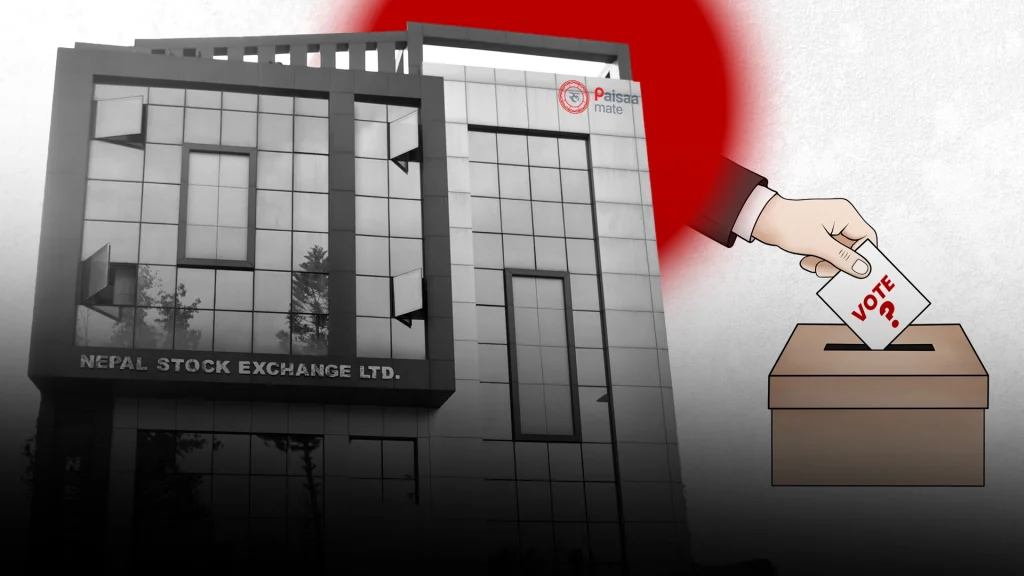
Nepal is currently witnessing a highly charged election atmosphere. On one side, newly emerged political forces are gaining rapid popularity. On the other, traditional parties are tightening their grip, determined to protect their long-held political dominance. Since the rise of the Gen Z–led movements, Nepal’s political landscape has undergone a visible shift. This has created mixed reactions among the public some are optimistic, believing the upcoming election could bring stability and meaningful reform, while others fear a fragmented mandate, a hung parliament, and yet another phase of political uncertainty.
In this environment, Nepal’s stock market cannot be viewed in isolation. Historically, political developments in Nepal have had a direct and noticeable impact on market sentiment and performance.
At present, the NEPSE index has been fluctuating around the 2600–2700 range. While some investors expect the market to rally after the election, others remain cautious, concerned that post-election instability or unclear leadership could push the market lower.
What kind of election will take place, what the results will be, and whether a new government will be able to introduce meaningful initiatives and development agendas, only time will tell.
However, based on a detailed study of past data and political-market linkages, we have analyzed how elections tend to influence Nepal’s stock market.
Formal trading in Nepal’s stock market began in 1997 A.D. (Fiscal Year 2053/54 B.S.) with the establishment of the Nepal Stock Exchange (NEPSE) at 1994 A.D. Since NEPSE was Started formally trading, five general elections have been successfully held in Nepal, and the upcoming election will mark the sixth such electoral cycle during the market’s existence.
1st Election: (2056 B.S)
The first general election after the establishment of NEPSE was the 3rd House of Representatives election held in 2056 B.S. (1999 A.D.) in two phases. A total of 39 political parties and 2,238 candidates participated, though only six parties secured national party status. The Nepali Congress formed the government under Krishna Prasad Bhattarai, with the opposition led by Madhav Kumar Nepal (CPN-UML). Although the House of Representatives functioned for only two years and eleven months, the post-election period witnessed major political events, including the declaration of a State of Emergency against the Maoist insurgency, the Royal Massacre, and the eventual dismissal of Prime Minister Sher Bahadur Deuba by King Gyanendra. Despite this political instability, NEPSE showed strong post-election performance, rising by around 11% before the election, 10–12% within two months after, nearly 73% within one year, and reaching a peak gain of approximately 170% from the election level, highlighting that market momentum after elections can remain strong even when political stability is short-lived.
| Election Date | Before (2 Months) | After (Within 2 month) | After (Within 1 Year) | After (Highest Gain) |
| 2056/01/20 2056/02/03 | 11% | 10.00% | 73.00% | 170.00% |
Table 01: NEPSE Reaction Before and After Election
2nd Election: 2064/12/28
The second major election relevant to NEPSE analysis was the Constituent Assembly election held on 2064/12/28 B.S. (April 10, 2008). This election fundamentally reshaped Nepal’s political structure, with 32 political parties gaining national party recognition and 594 representatives elected, later forming a 601-member Constituent Assembly including government nominees. The post-election period was marked by extreme political instability, frequent leadership changes, and prolonged power vacuums. The Maoist party, led by Pushpa Kamal Dahal (Prachanda), formed the first government, followed by successive prime ministers including Madhav Kumar Nepal, Jhalanath Khanal, and Dr. Baburam Bhattarai, with repeated failures to secure parliamentary majority and nearly seven months of leadership vacuum. Reflecting this uncertainty, NEPSE declined by around 4% in the two months before the election, surged 25% within two months after, but fell 12% within one year, before reaching a post-election peak gain of approximately 57.5% indicating that while elections triggered short-term rallies, sustained political instability limited long-term market performance during this period.
| Election Date | Before (2 Months) | After (Within 2 month) | After (Within 1 Year) | After (Highest Gain) |
| 2064/12/28 | -4% | 25.00% | -12.00% | 57.5.00% |
Table 02: NEPSE Reaction Before and After Election
3rd Election: 2070/08/04
The third election considered in NEPSE’s post-establishment history was the second Constituent Assembly election held on 2070/08/04 B.S. (November 13, 2013), conducted after the failure of the interim constitution-based government formed in 2063 B.S. to deliver a new constitution within the promised timeframe. In this election, 575 Constituent Assembly members were elected through direct (240) and proportional (335) representation, with 30 political parties participating. Following the election, Sushil Koirala was appointed Prime Minister on 2070 Magh 27, with major support from Ram Chandra Poudel and KP Sharma Oli, bringing relative political clarity after a prolonged transition period. Reflecting renewed investor confidence, NEPSE rose by around 9% in the two months before the election, surged 32% within two months after, gained approximately 52% within one year, and eventually reached a post-election peak of nearly 215%, making this period one of the strongest and most sustained bull runs in NEPSE history.
| Election Date | Before (2 Months) | After (Within 2 month) | After (Within 1 Year) | After (Highest Gain) |
| 2070/08/04 | 9% | 32% | 52% | 215% |
Table 03: NEPSE Reaction Before and After Election
4th Election: (2074/08/10, 2074/08/21)
The fourth election in NEPSE’s post-establishment timeline was the two-phase election of the fifth House of Representatives held on 2074/08/10 and 2074/08/21 B.S. (December 2017), which elected 275 members through direct (165) and proportional (110) systems and produced Nepal’s first-ever two-thirds majority government, later weakened by internal division within the ruling UML. Following the final results, K.P. Sharma Oli of the CPN-UML was sworn in as Prime Minister on 2074 Falgun 3 under Article 76(2) of the Constitution and secured a vote of confidence with 208 votes. Only eight parties gained national party status, signaling a relatively consolidated political mandate. Despite this apparent political strength, NEPSE showed weak short- to medium-term performance, declining by about 1% in the two months before the election, falling 10% within two months after, and dropping nearly 28% within one year; however, over the longer term, the market eventually staged a strong recovery, reaching a post-election peak gain of approximately 110%, demonstrating that even elections producing strong parliamentary majorities do not guarantee immediate market optimism.
| Election Date | Before (2 Months) | After (Within 2 month) | After (Within 1 Year) | After (Highest Gain) |
| 2074/08/10 2074/08/21 | -1.00% | – 10.00% | -28.00% | 110.00% |
Table 04: NEPSE Reaction Before and After Election
5th Election: (2079/08/04)
The fifth general election, held on 2079/08/04 B.S. (November 20, 2022), clearly reflected growing public frustration with long-standing political actors and a strong desire for change, leading to the formal emergence of alternative politics through a new party led by prominent media personality Rabi Lamichhane. This election reshaped Nepal’s political narrative, even as traditional parties remained dominant among the top contenders. In terms of market behavior, NEPSE gained approximately 5.5% in the two months before the election and rose 15% within two months after, indicating short-term optimism; however, the index declined by around 6.5% within one year, reflecting continued political uncertainty and coalition fragility. Over the longer term, the market still managed a recovery, reaching a post-election peak gain of about 58%, suggesting that while elections increasingly reflect voter discontent and political fragmentation, NEPSE continues to respond positively in cycles once uncertainty begins to clear.
| Election Date | Before (2 Months) | After (Within 2 month) | After (Within 1 Year) | After (Highest Gain) |
| 2079/08/04 | 5.50% | 15.00% | -6.50% | 58.00% |
Table 05: NEPSE Reaction Before and After Election
A review of all five elections held since the establishment of NEPSE shows a consistent and revealing pattern in market behavior. On average, NEPSE delivered a 4.05% gain in the two months before elections, suggesting cautious optimism ahead of political events. More notably, the market recorded an average 18.4% rise within two months after elections, indicating that elections tend to act as a short-term confidence trigger for investors. Within one year after elections, the average return stood at 15.7%, reflecting mixed outcomes influenced by post-election stability or instability. However, the most striking insight emerges from the long-term perspective: across all election cycles, NEPSE achieved an average highest gain of 138.25%, demonstrating that despite political uncertainty, coalition fragility, or governance failures, Nepal’s stock market has historically delivered substantial upside once uncertainty gradually clears and liquidity cycles turn favorable.
| Election Date | Before (Within 2 Months) | After (Within 2 month) | After (Within 1 Year) | After (Highest Gain) |
| 2056/01/20 2056/02/03 | 11% | 10.00% | 73.00% | 170.00% |
| 2064/12/28 | -4% | 25.00% | -12.00% | 57.5.% |
| 2070/08/04 | 9% | 32% | 52% | 215% |
| 2074/08/10 2074/08/21 | -1.00% | 10.00% | -28.00% | 110.00% |
| 2079/08/04 | 5.50% | 15.00% | -6.50% | 58.00% |
| Average | 4.05% | 18.40% | 15.70% | 138.25% |
Table 05: Summary of all the Election and their Average Growth
As Nepal approaches the upcoming election on Falgun 21 (March 5), investor focus has once again shifted toward the potential impact on the stock market. Historical evidence clearly shows that elections in Nepal often act as short-term confidence triggers, with NEPSE recording an average gain of 18.4% within two months after past elections. However, history also delivers an important lesson: an election alone, or even the formation of a “good” government, cannot fully control the direction of NEPSE. Political events influence sentiment, but the stock market ultimately responds more strongly to broader economic conditions, liquidity cycles, interest rates, and overall investor confidence.
Looking at previous election cycles, the market has sometimes rallied despite political instability, while at other times it has declined even after strong majority governments were formed. This clearly demonstrates that NEPSE operates within larger economic and liquidity cycles. Currently, Nepal’s financial system is experiencing excess liquidity in the banking sector, and interest rates are gradually moving toward single digits. Lower interest rates reduce borrowing costs and historically create a supportive environment for equity markets, as investors tend to shift funds from fixed-income instruments toward stocks. At the same time, inflation pressures appear more stable compared to crisis periods, and market participation is significantly higher than in earlier decades.
Therefore, the real question is not simply who wins the election, but whether the post-election government can ensure policy continuity, economic stability, and confidence in the private sector. If political clarity emerges quickly and governance remains stable, NEPSE may follow its historical pattern of short-term post-election optimism. However, if coalition fragility or leadership uncertainty persists, volatility could continue before a clear trend develops. Ultimately, while the Falgun 21 election may act as a catalyst for market movement, the sustainability of any bull run will depend far more on economic fundamentals, liquidity conditions, and the broader market cycle than on political outcomes alone.